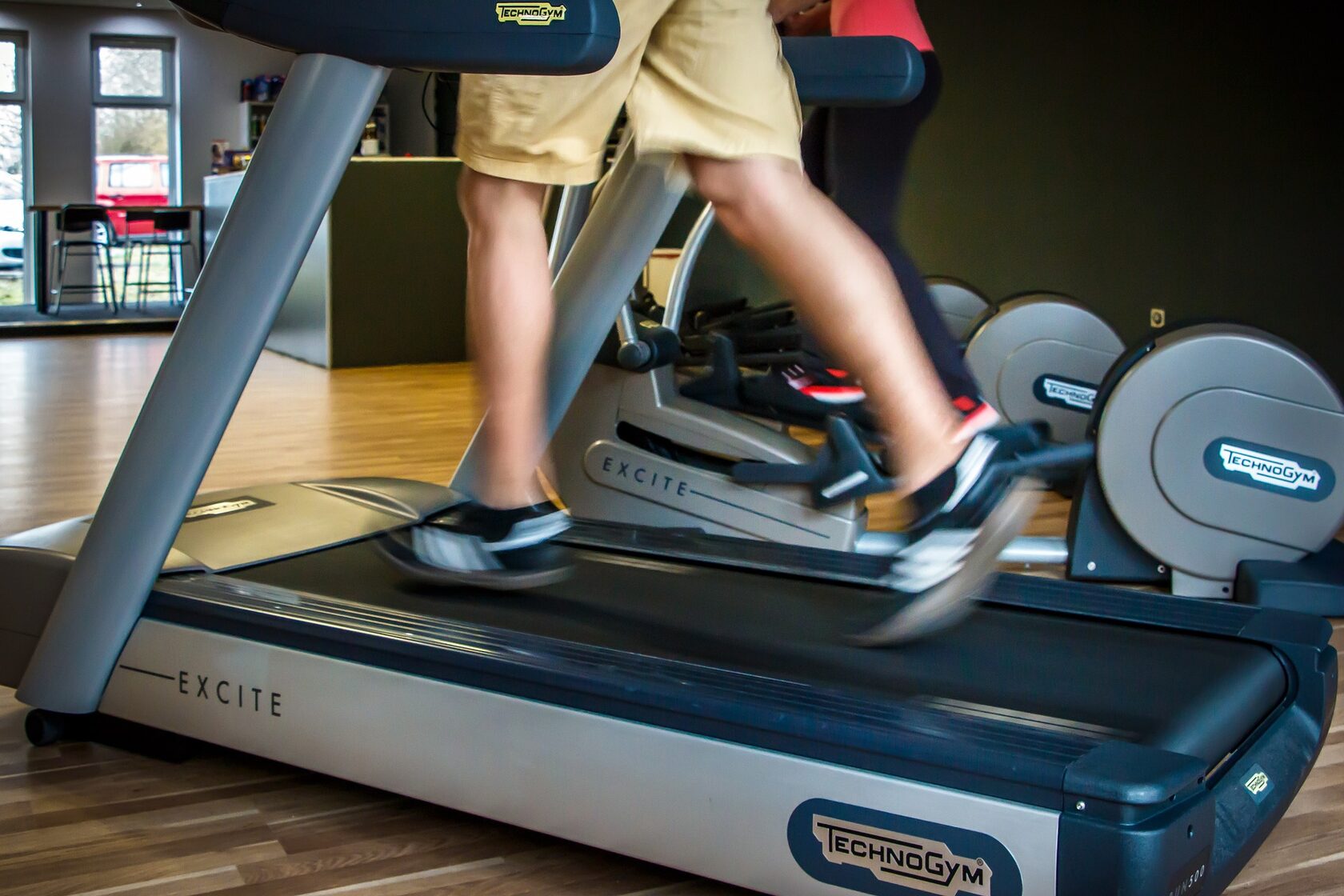
You can still perform, but the physical cost has crept up. The sprint to the gate leaves you blowing harder than it should. Three flights of stairs, and you are talking in fragments at the top. Your aerobic capacity, the thing that used to be a non-issue, has quietly become something you notice. You do not feel unfit exactly. You feel like the same effort buys less than it did five years ago.
VO2 max is the ceiling on how much oxygen your body can use under load, the single best exercise-measured proxy for how much physiological reserve you have left, and interval training is the most time-efficient way to raise it.
That last part matters, because the reason most capable operators never train it is not laziness. It is a time budget. This post is the how-to: what actually moves the number, how much time it costs (less than you think), and why the figure on your watch is the least trustworthy part of the whole exercise.
Why does the same effort cost more than it used to?
VO2 max is your aerobic engine's size, the maximum rate at which your heart, lungs, blood, and muscles can take in oxygen and turn it into usable energy. It is set by how much blood your heart moves per beat, how well your vessels dilate, and how densely your muscles are packed with mitochondria.
Left alone, this engine shrinks. Sedentary adults lose roughly ten percent of their VO2 max per decade after thirty, and the decline accelerates later. This is textbook physiological erosion: slow, invisible year to year, and obvious only once it compounds into "I get winded doing things I used to do without thinking." The felt symptom is lagging behind a mechanical change that started years earlier.
Here is the part that reframes it for a leader. VO2 max is not a fitness vanity metric. It is one of the strongest single predictors of how long you stay functional. In a study of 122,007 adults (Mandsager et al., JAMA Network Open, 2018), the least-fit group carried roughly five times the all-cause mortality of the elite-fit group, and the analysis found no upper limit, more fitness kept tracking with lower risk. A declining aerobic ceiling is hidden biological debt in its purest form.
What actually raises it?
Steady easy cardio maintains the base but barely lifts the ceiling. To raise VO2 max you have to spend time near it, and that means intervals: hard efforts long enough to drive your oxygen uptake up toward its maximum, repeated with recovery in between.
The most-studied protocol is the Norwegian 4x4, developed at NTNU in Norway. Four efforts of four minutes at roughly 85 to 95 percent of maximum heart rate, each followed by three minutes of easy active recovery. Across the research this format produces roughly a seven to ten percent VO2 max gain over eight weeks, alongside improvements in how much blood the heart moves per beat and how well the vessels respond. Two sessions a week is the standard dose.
Do the arithmetic on the objection. Two 4x4 sessions is about fifty minutes of actual work per week, including the recovery blocks. That is the entire cost of the highest-leverage longevity input available to you. This is performance infrastructure, not another thing to squeeze onto the calendar.
Is the 4x4 the only way?
No, and this is where honesty beats dogma. What raises VO2 max is total time spent near your maximum oxygen uptake. The 4x4 is simply a reliable, well-tested way to accumulate it, around eight minutes at the top end per session.
If four-minute efforts feel brutal enough that you dread them and skip them, shorter formats get you to a similar place. A 30/30 (thirty seconds hard, thirty seconds easy, repeated) accumulates nearly the same time near VO2 max while feeling more manageable, because the brief recoveries never let your heart rate fall far. The evidence does lean toward longer intervals for well-trained athletes squeezing out the last few percent, but for a time-poor operator the best protocol is the one you will actually repeat twice a week. Consistency is the active ingredient. The protocol is just the delivery mechanism.
Why not just trust the number on my watch?
Because the absolute VO2 max figure your watch shows you is the least reliable layer in the whole system. A 2025 Apple Watch validation study (PLOS One) found the watch underestimated lab-measured VO2 max by about six points on average, with a mean error of roughly thirteen percent and a 95 percent agreement range spanning more than twenty-four ml/kg/min. In plain terms, your true value could sit six points above the watch's number or eighteen below it. A broader systematic review of wearables found the same pattern: the average across many users looks fine, but any single person's reading carries a wide error band.
So do not chase the displayed number or compare it to a friend's. The signal is not the value, it is the direction. Held on the same device, under similar conditions, over eight to twelve weeks, the trend is meaningful even when the absolute figure is off. Watch for the number drifting up, and for the field evidence underneath it: the same pace at a lower heart rate, faster recovery of your heart rate after a hard effort, easier breathing on the stairs that started this whole thing.
What is the minimum-effective protocol?
Three moves, roughly fifty minutes a week.
First, pick one interval format and commit to twice a week. Default to the Norwegian 4x4: after a warm-up, four by four minutes hard (you can speak only a word or two at the top, not a full sentence), three minutes easy between. If four minutes is too much to face, run a 30/30 block for about fifteen to twenty minutes instead. Mode does not matter, use a bike, rower, incline treadmill, or hills, whatever spares your joints.
Second, keep the rest of your week genuinely easy. Intervals raise the ceiling; easy aerobic work and sleep build the recovery capacity that lets you absorb them. Two hard sessions stacked on no recovery is how you get injured, not fitter.
Third, measure the trend, not the day. Hold one device, note your pace at a fixed easy heart rate and your heart-rate recovery after efforts, and read them over weeks. Give it eight weeks before you judge the protocol.
Map where your system is carrying load
If getting winded more easily is one of several signals you have been quietly noting, and you have not stopped to see how they add up, that is worth a structured look. The free self-assessment at https://osapiens.expert/how-i-feel maps where your system is carrying load across sleep, stress, recovery, and physical capacity, so your next move is based on your actual baseline instead of a guess.
One caution before you start. If you get chest pain or pressure, unusual breathlessness, palpitations, or lightheadedness during exertion, or your resting heart rate simply will not settle, stop and see a physician before pushing intensity. If you are new to hard training or have any cardiac history, get cleared first. And if the fatigue behind all this is constant and unexplained, or your partner reports snoring or gasping in your sleep, that points to something a training plan will not fix, so take it to a professional.
Written by Vlad Andreev, mental health educator and executive coach, founder of O!Sapiens. This is education, not medical advice.