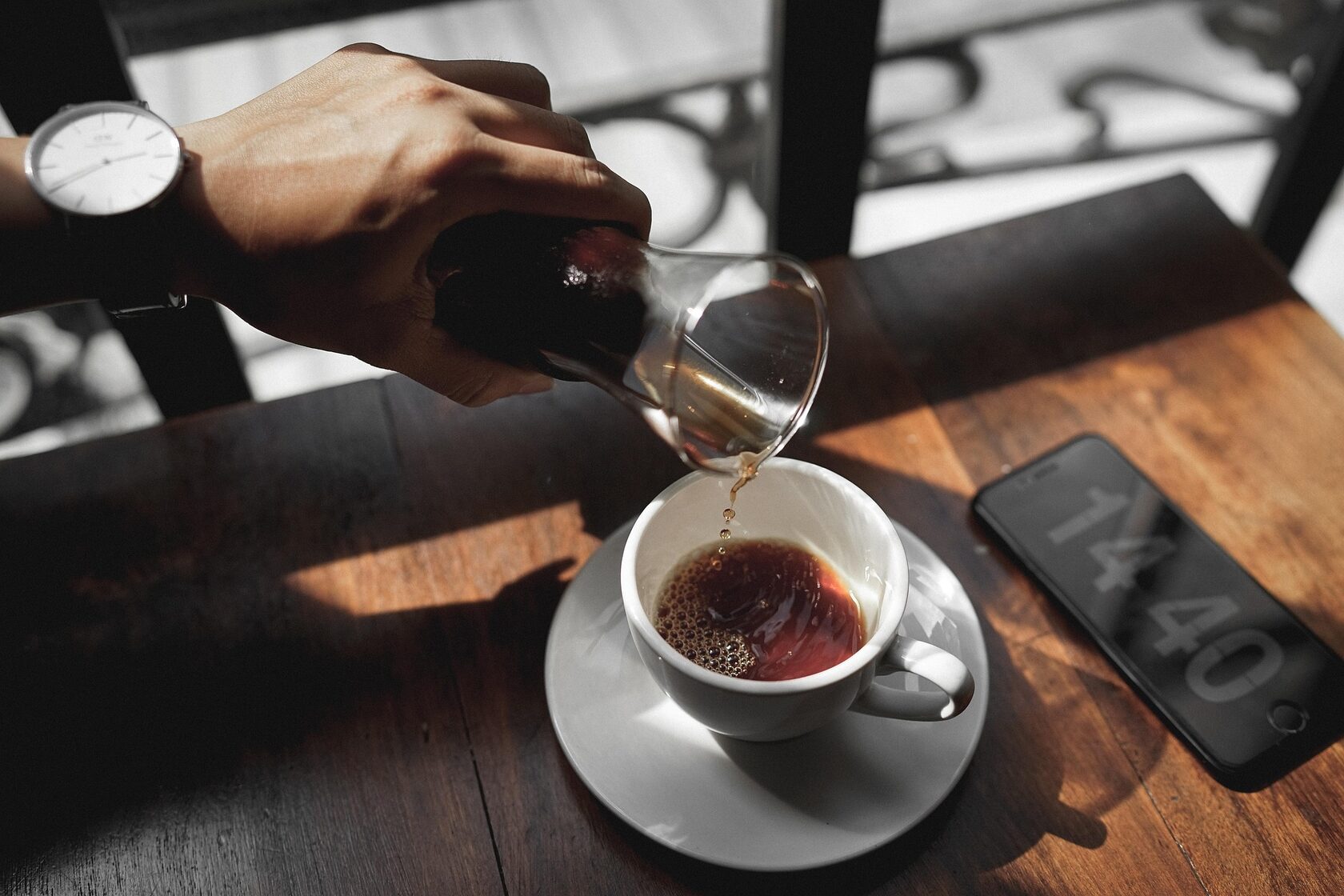
You feel the wall hit around 3pm. Focus thins, the inbox stops making sense, and the fastest lever in reach is another coffee. It works. You get two more sharp hours and close out the day. Then you get into bed at a reasonable hour, fall asleep fine, and still wake up feeling like the night did not count. The hours were there. The recovery was not.
Caffeine timing is the gap between when your coffee stops feeling like it is working and when it actually stops working on your brain, and that gap is where your deep sleep gets quietly taxed. The drink that rescues your afternoon is often the same drink that thins the night you needed.
This is not a lecture about quitting coffee. Caffeine is one of the best-studied performance tools available, and used well it earns its place. The problem is almost never the coffee itself. It is the clock.
Why does afternoon coffee cost me sleep I do not feel losing?
Caffeine has a half-life of roughly five to six hours in a healthy adult. That means about half of a 2pm coffee is still circulating at 7 or 8pm, and a meaningful fraction is still active when your head hits the pillow. You cleared the alertness feeling long ago. The molecule is still in the room.
Here is the mechanism that matters. Across the day, a compound called adenosine accumulates in the brain. Rising adenosine is a large part of what builds sleep pressure, the biological push toward rest that makes sleep deep when it finally comes. Caffeine does not remove adenosine. It blocks the receptors adenosine would normally dock onto, so the tiredness signal is muted while the adenosine keeps piling up behind the blockade.
That is why the afternoon coffee feels free. You are not adding energy. You are borrowing against sleep pressure and hiding the invoice. When the caffeine finally clears overnight, all of that backed-up adenosine lands at once, but the window where it should have driven deep, restorative sleep has already partly passed. This is textbook hidden biological debt: a cost that does not show up in the moment and settles later, on the ledger of your recovery capacity.
What does the research actually show about dose and timing?
Two findings are worth holding onto.
A 2023 systematic review and meta-analysis in Sleep Medicine Reviews (Gardiner and colleagues) pooled controlled caffeine trials and found that caffeine cut total sleep time by about 45 minutes, reduced sleep efficiency by roughly 7 percent, and increased the time spent awake during the night. Notably, this happened even when caffeine did not stop people falling asleep. Sleep still started. It just held less.
The more precise picture comes from a 2025 randomized crossover trial in the journal SLEEP, which tested 100mg and 400mg of caffeine taken 12, 8, or 4 hours before bed. A 100mg dose, roughly a single espresso, showed no significant effect on sleep even taken 4 hours before bed. A 400mg dose, closer to a large brewed coffee or a strong pre-workout, significantly delayed sleep onset and altered sleep architecture when taken within 12 hours of bed, and produced markedly more sleep fragmentation when taken within 8 hours. The closer to bedtime, the worse the hit.
Read those two together and the takeaway is not that caffeine is bad. It is that both dose and timing decide the cost, and the large late dose is the expensive one.
What can I actually measure?
If you wear a device, this is one of the cleaner cause-and-effect signals you can watch, because you control the input. The markers that move are deep sleep or slow-wave sleep percentage, sleep efficiency, and overnight resting heart rate, which tends to run higher when caffeine is still active during the night. Nighttime HRV often reads lower on heavy late-caffeine nights.
One caution on interpretation. A single flat night proves nothing. Devices are noisy, and the composite recovery score your app shows is the least trustworthy layer of the data. The honest signal is a pattern: lower deep sleep and elevated resting heart rate on the nights that followed a late or large caffeine dose, repeated across several instances. Run it as a small experiment. Hold your last coffee to before 2pm for a week, keep everything else roughly constant, and compare deep sleep and resting heart rate against your usual week. You are not chasing a perfect number. You are looking for a direction.
Why does it feel like the coffee is not even affecting me?
Because tolerance masks the sleep cost. Regular caffeine users stop feeling wired from a late coffee long before the drug stops shaping their sleep architecture. It doesn't keep me up is true and beside the point. Falling asleep is not the metric. Sleep quality is. You can drop off within minutes and still lose deep sleep to caffeine that is quietly holding your adenosine receptors hostage until 2am.
There is also a compounding trap worth naming. Poor deep sleep leaves you more depleted the next afternoon, which makes the 3pm coffee feel more necessary, which taxes the next night. That is a loop, and it runs on nervous-system-first logic: the tired system reaches for the fastest override, and the override degrades the recovery that would have fixed the tiredness. Willpower does not break that loop. A rule about timing does.
What is the minimum-effective protocol?
You do not need to quit. You need a cutoff and a couple of guardrails. Total time cost is a few minutes of planning.
Set a hard caffeine cutoff about 8 to 10 hours before your target bedtime. For an 11pm bedtime, that lands your last coffee around 1pm to 2pm, leaving one to two half-lives to clear before sleep.
Front-load the dose. Keep the meaningful caffeine in the first half of your day when it does the most work and costs the least sleep. If you need something at 3pm, make it small, a single shot rather than a large cup, since the research is far kinder to 100mg than to 400mg.
Treat the afternoon crash as information, not just a problem to caffeinate over. A ten-minute walk, daylight, water, or a genuine two-minute pause often buys back more usable focus than a fourth coffee, without the overnight tax. The crash is frequently a signal that the morning's recovery capacity was already thin.
If you travel across time zones or work late deliberately, anchor the cutoff to your destination or actual sleep window, not the clock on the wall.
None of this is about virtue. It is asset protection. Your deep sleep is where tomorrow's judgment gets built, and a coffee timed badly is one of the cheapest ways to lose it without noticing.
One honest boundary: if you feel wired-but-tired every night regardless of caffeine timing, if you snore or gasp during sleep, or if you have persistent unexplained fatigue or low mood, that is not a caffeine-timing problem. Possible sleep apnea, depression, and chronic fatigue are medical questions. Bring them to a physician rather than trying to out-optimize them.
If you want to see where your own system is carrying load, the free O!Sapiens self-assessment at https://osapiens.expert/capacity maps sleep, recovery, and stress against the pillars in about ten minutes, so you can tell whether the afternoon coffee is the problem or just the symptom. It is a baseline, not a prescription.
Written by a mental health educator and executive coach, founder of O!Sapiens. This is education, not medical advice. It is not a diagnosis or a treatment plan. For persistent sleep problems, fatigue, or mood changes, consult a qualified physician or professional.
Caffeine timing is the gap between when your coffee stops feeling like it is working and when it actually stops working on your brain, and that gap is where your deep sleep gets quietly taxed. The drink that rescues your afternoon is often the same drink that thins the night you needed.
This is not a lecture about quitting coffee. Caffeine is one of the best-studied performance tools available, and used well it earns its place. The problem is almost never the coffee itself. It is the clock.
Why does afternoon coffee cost me sleep I do not feel losing?
Caffeine has a half-life of roughly five to six hours in a healthy adult. That means about half of a 2pm coffee is still circulating at 7 or 8pm, and a meaningful fraction is still active when your head hits the pillow. You cleared the alertness feeling long ago. The molecule is still in the room.
Here is the mechanism that matters. Across the day, a compound called adenosine accumulates in the brain. Rising adenosine is a large part of what builds sleep pressure, the biological push toward rest that makes sleep deep when it finally comes. Caffeine does not remove adenosine. It blocks the receptors adenosine would normally dock onto, so the tiredness signal is muted while the adenosine keeps piling up behind the blockade.
That is why the afternoon coffee feels free. You are not adding energy. You are borrowing against sleep pressure and hiding the invoice. When the caffeine finally clears overnight, all of that backed-up adenosine lands at once, but the window where it should have driven deep, restorative sleep has already partly passed. This is textbook hidden biological debt: a cost that does not show up in the moment and settles later, on the ledger of your recovery capacity.
What does the research actually show about dose and timing?
Two findings are worth holding onto.
A 2023 systematic review and meta-analysis in Sleep Medicine Reviews (Gardiner and colleagues) pooled controlled caffeine trials and found that caffeine cut total sleep time by about 45 minutes, reduced sleep efficiency by roughly 7 percent, and increased the time spent awake during the night. Notably, this happened even when caffeine did not stop people falling asleep. Sleep still started. It just held less.
The more precise picture comes from a 2025 randomized crossover trial in the journal SLEEP, which tested 100mg and 400mg of caffeine taken 12, 8, or 4 hours before bed. A 100mg dose, roughly a single espresso, showed no significant effect on sleep even taken 4 hours before bed. A 400mg dose, closer to a large brewed coffee or a strong pre-workout, significantly delayed sleep onset and altered sleep architecture when taken within 12 hours of bed, and produced markedly more sleep fragmentation when taken within 8 hours. The closer to bedtime, the worse the hit.
Read those two together and the takeaway is not that caffeine is bad. It is that both dose and timing decide the cost, and the large late dose is the expensive one.
What can I actually measure?
If you wear a device, this is one of the cleaner cause-and-effect signals you can watch, because you control the input. The markers that move are deep sleep or slow-wave sleep percentage, sleep efficiency, and overnight resting heart rate, which tends to run higher when caffeine is still active during the night. Nighttime HRV often reads lower on heavy late-caffeine nights.
One caution on interpretation. A single flat night proves nothing. Devices are noisy, and the composite recovery score your app shows is the least trustworthy layer of the data. The honest signal is a pattern: lower deep sleep and elevated resting heart rate on the nights that followed a late or large caffeine dose, repeated across several instances. Run it as a small experiment. Hold your last coffee to before 2pm for a week, keep everything else roughly constant, and compare deep sleep and resting heart rate against your usual week. You are not chasing a perfect number. You are looking for a direction.
Why does it feel like the coffee is not even affecting me?
Because tolerance masks the sleep cost. Regular caffeine users stop feeling wired from a late coffee long before the drug stops shaping their sleep architecture. It doesn't keep me up is true and beside the point. Falling asleep is not the metric. Sleep quality is. You can drop off within minutes and still lose deep sleep to caffeine that is quietly holding your adenosine receptors hostage until 2am.
There is also a compounding trap worth naming. Poor deep sleep leaves you more depleted the next afternoon, which makes the 3pm coffee feel more necessary, which taxes the next night. That is a loop, and it runs on nervous-system-first logic: the tired system reaches for the fastest override, and the override degrades the recovery that would have fixed the tiredness. Willpower does not break that loop. A rule about timing does.
What is the minimum-effective protocol?
You do not need to quit. You need a cutoff and a couple of guardrails. Total time cost is a few minutes of planning.
Set a hard caffeine cutoff about 8 to 10 hours before your target bedtime. For an 11pm bedtime, that lands your last coffee around 1pm to 2pm, leaving one to two half-lives to clear before sleep.
Front-load the dose. Keep the meaningful caffeine in the first half of your day when it does the most work and costs the least sleep. If you need something at 3pm, make it small, a single shot rather than a large cup, since the research is far kinder to 100mg than to 400mg.
Treat the afternoon crash as information, not just a problem to caffeinate over. A ten-minute walk, daylight, water, or a genuine two-minute pause often buys back more usable focus than a fourth coffee, without the overnight tax. The crash is frequently a signal that the morning's recovery capacity was already thin.
If you travel across time zones or work late deliberately, anchor the cutoff to your destination or actual sleep window, not the clock on the wall.
None of this is about virtue. It is asset protection. Your deep sleep is where tomorrow's judgment gets built, and a coffee timed badly is one of the cheapest ways to lose it without noticing.
One honest boundary: if you feel wired-but-tired every night regardless of caffeine timing, if you snore or gasp during sleep, or if you have persistent unexplained fatigue or low mood, that is not a caffeine-timing problem. Possible sleep apnea, depression, and chronic fatigue are medical questions. Bring them to a physician rather than trying to out-optimize them.
If you want to see where your own system is carrying load, the free O!Sapiens self-assessment at https://osapiens.expert/capacity maps sleep, recovery, and stress against the pillars in about ten minutes, so you can tell whether the afternoon coffee is the problem or just the symptom. It is a baseline, not a prescription.
Written by a mental health educator and executive coach, founder of O!Sapiens. This is education, not medical advice. It is not a diagnosis or a treatment plan. For persistent sleep problems, fatigue, or mood changes, consult a qualified physician or professional.